In early 2023, I made my first trip to Syria. Then another. Then another. By the end of the year, I’d crossed the border at least eleven times, perhaps more. As a tour guide, I was taking people into a country that almost every embassy had warned them not to approach. I knew it was controversial, I knew how it looked, and I dealt with the backlash. At best, I was called reckless and at worst, I was accused of being a regime supporter, which couldn’t be further from the truth.
The irony? I loathed Bashar al-Assad. I know hating is wrong, but it was well placed with him. In some weird way, I felt that visiting Syria wasn’t enabling him; to me, it was an act of rebellion against him. I didn’t want one man to be the face of an entire nation; I wasn’t there for him; I was there to see, to listen, to understand. As I did, I fell in love with Syria, and so I brought people who wanted to learn more about this incredible country. I knew it made me unlikable to some, but I trusted my own heart and believed in what I was doing.
Back then, Syria was still firmly under Assad’s rule, his face was everywhere, not metaphorically, but literally. The moment you crossed the border, you saw it. Plastered on posters, stuck on shop windows, framed in restaurants, painted onto crumbling walls, printed on tea cups (I gave up tea). One time, I saw him printed across the side of a truck, riding a white horse like some knock-off James Bond. Honestly, it was funny and disturbing; it takes a certain level of narcissism to believe that looks cool. But that’s what I came to understand about propaganda, especially in authoritarian systems: it’s not there to convince you. It’s there to wear you down. The more I visited, the more I realised that people didn’t believe it; they just had to not question it.
Coming from Australia, where we laugh at our politicians and vote them out over bad haircuts or even not chugging a beer quickly enough, the idea of forced reverence felt… alien. I used to think, “Surely people don’t fall for this?” And most didn’t. But they still played along because not playing came with consequences. I even felt that way; I knew my contribution to the Australian tax system wasn’t going to secure a ransom, so I also kept quiet.
I met Syrians who whispered criticism over coffee in the kitchen. Some cracked jokes about the regime, but only once the curtains were drawn, and as much as I wanted to hear more, I often found myself shutting conversations down. Not because I didn’t want to know, but because I couldn’t guarantee their safety or mine. In Syria, even the friendliest face might work for Assad, and I felt conflicted because it wasn’t personal; it was survival.
The Dictator Falls
By early 2024, Syria felt… paused. Like a war that had run out of motion, Assad still held Damascus and the major cities. Idlib, that haunting rebel enclave in the northwest, was still out of regime control, a place I’d driven past eleven times, always told, “That’s Idlib, but don’t even think about going.” It was portrayed like Mosul under ISIS, and I did believe that if I crossed into it, it was the equivalent of walking into an ISIS cell.
Then something shifted, which on reflection was the perfect recipe.
First came Russia, Assad’s lifeline for almost a decade. But by 2024, Putin was knee-deep in Ukraine and overextended. Syria wasn’t a priority anymore, and the Russian troops I saw time and time again had bigger problems than Syria.
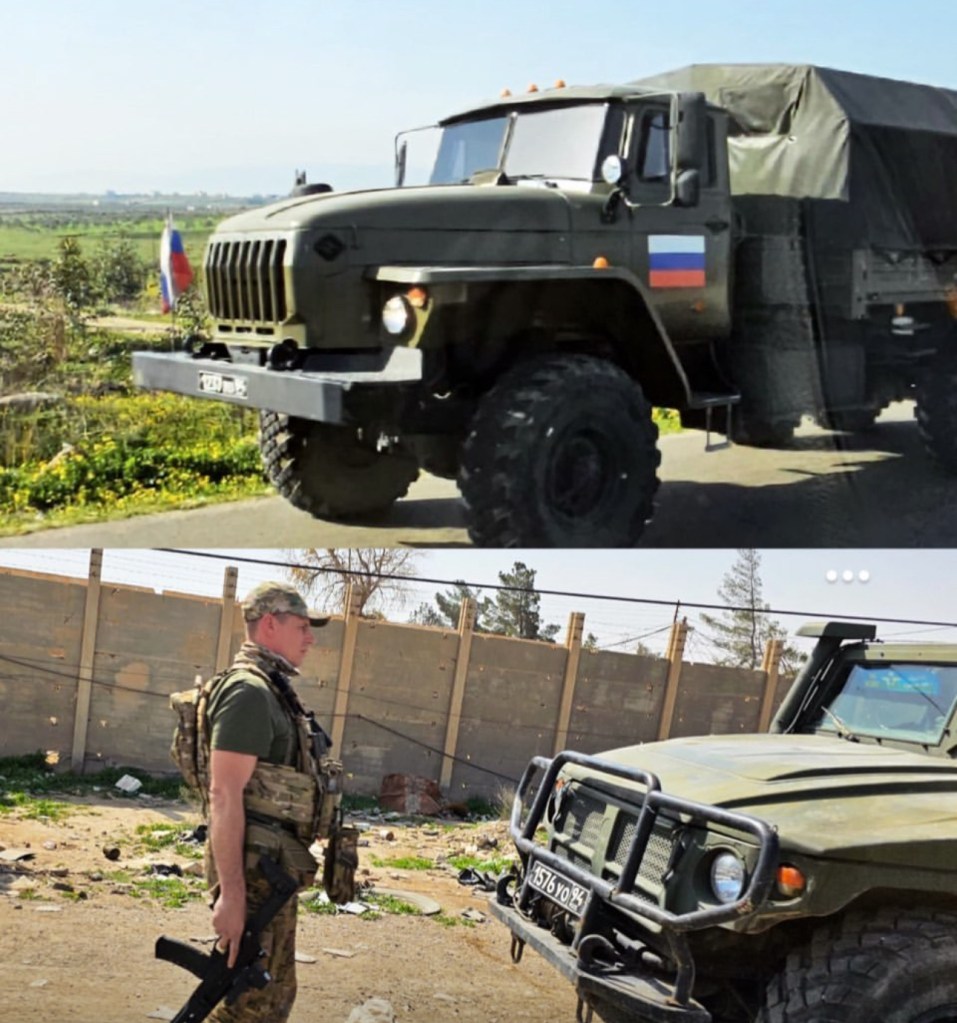
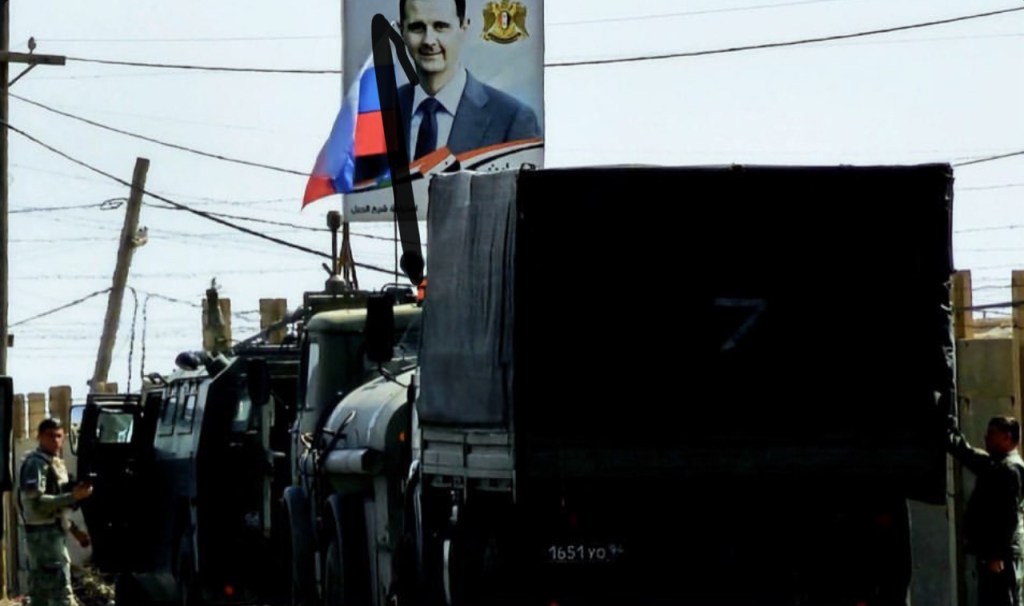
Russian troops in Syria in 2023
Next came Iran. When war broke out in Gaza in October 2023, Iran pivoted; they had to, their proxy Hezbollah repositioned its fighters along the Israeli border, and their focus turned south.
Essentially, for the first time in years, Assad stood alone.
Syrians noticed. Friends in Aleppo messaged me that checkpoints were thinning, and they weren’t sure if they should be hopeful or go to Damascus, a strongpoint throughout for Assad. The soldiers, many of them conscripts earning less than $30 a month, were disappearing. Who exactly were they fighting for and why?. As Jim Jefferies once said, “Not a lot of wiggle room to be a f***ing hero.” When survival is your job, you don’t die for a man who would never die for you and is paying you next to nothing.
Then, in November, everything seemed to shift quickly. A coalition of rebels led by Hay’at Tahrir al-Sham (HTS), an Islamist group once linked to al-Qaeda, launched a full-blown offensive from Idlib. I’d passed that region so many times, but I never thought it could redraw Syria’s borders.
I’ll never forget seeing the Citadel in Aleppo, a place I’d stood in front of on every single visit, now flying the HTS flag. In that moment, it hit me that this wasn’t just another headline or skirmish. Assad’s days were numbered. Still, I thought he’d go down swinging.
On December 8th, 2024, Bashar al-Assad fled Damascus for Moscow. His exit was as cowardly as his rule. He even pre-recorded a final video to make it seem like he stayed and fought, but of course, he didn’t. He didn’t care about the people of Syria, so there was no last stand, more obviously, no apology. Instead, just a plane to Russia, where he lies in hiding, probably living his best life.
Questions That Follow
That night, it was announced over loudspeakers that Assad was gone. People flooded the streets, dancing and crying. They tore down statues of Hafez, stomped on portraits of Bashar, and an iconic image where young guys in Barzeh ripped down a billboard, screaming “Free Syria!” It gives me chills to this day.
The West was worried, but for those of us who cared, everything stopped, and what came next didn’t matter, even just for a magical moment. But, of course, the joy didn’t last forever; to this day, we still don’t know, but that brief period was more than five decades in the making and it deserved every inch of happiness.
HTS, for all its rebranding, is still authoritarian in its way, and Syria isn’t just Sunni or Muslim, it’s Christian, Alawite, Secular, and the new leader who promised inclusion hasn’t delivered a constitution of inclusion, especially to the Syrian Kurds, whom he made huge promises to.
A Country Reclaims Its Voice
I came back in April 2025 because, honestly, I had to. I never thought I’d live to see a Syria without Assad, and I certainly never imagined I’d see it in my twenties.
There were no checkpoints between Homs and Damascus. People spoke louder, and young girls yelled, joined in “free Syria” protests, and someone even hung a banner honouring victims of Sednaya Prison. I walked past and froze because that would’ve landed you in jail not long ago, it hit me he was gone, this is a new Syria.
But hope is tricky. It’s such a beautiful thing, the most beautiful of all, but also fragile because it means acknowledging it can all go wrong, yet what a wonderful thing to cling to something.
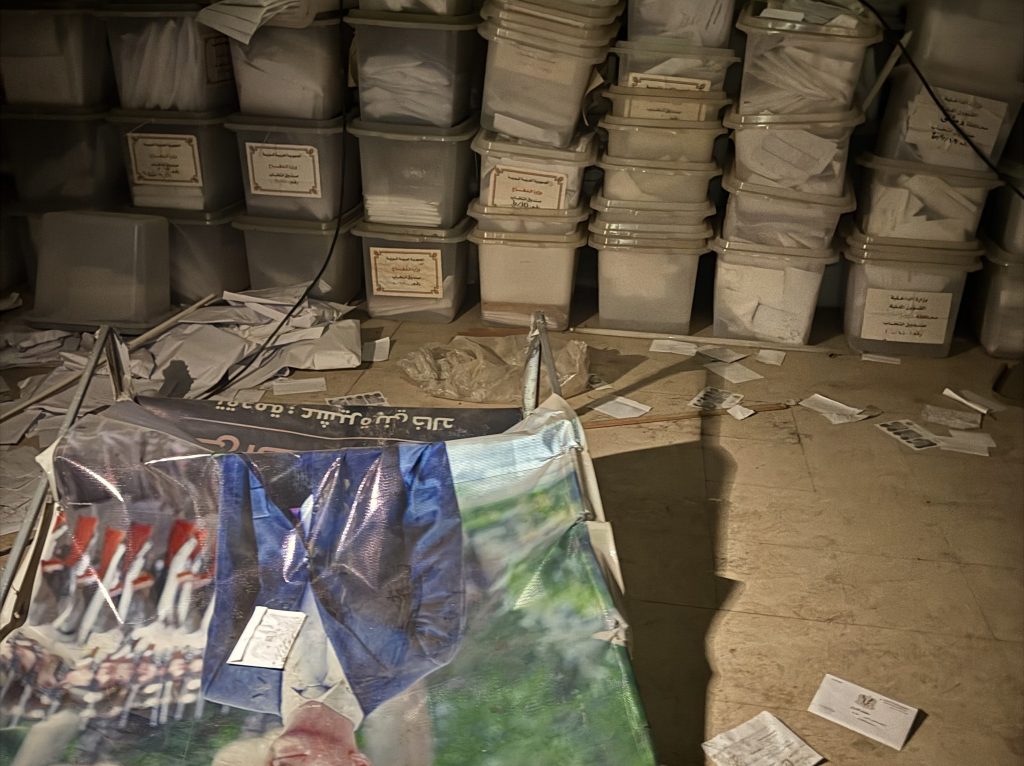
One afternoon, I visited an old Baath Party office in Damascus, a place I had unknowingly walked through with dozens of guests over the years. I always thought it was just storage, but I went deeper this time.
And I found them.
Ballots.
Hundreds of them.
From the 2021 “election” where Assad “won” 95%. Every single one is pre-marked. Not one for an opponent. Not even a blank. They were pristine. Never folded and never touched by actual voters. They were made to be stuffed, not counted.
I stood there with one in my hand, and I felt sick, genuinely sick. I knew the elections were rigged, but seeing it with my own eyes… it hurt. I grew up in a country with compulsory voting, and I loved that; it was so far from my norm. How could this happen? HOW? It was paper, so manipulative and disgusting, I questioned everything, I still don’t know how to describe it.
But that’s dictatorship, right? It’s not just bombs and prisons, it’s the small, boring fraud, lies in piles that are worked together to seem like truth. I kept thinking how many other places does this happen? And why do we continue to pretend it’s not our problem? Look at the world today.
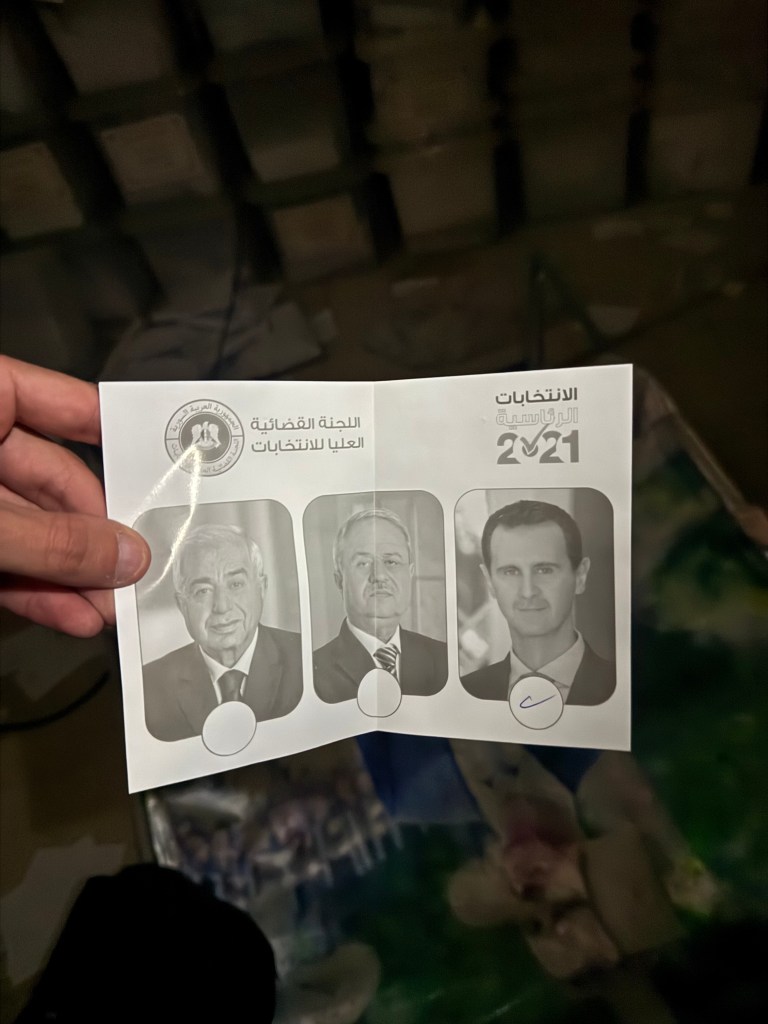
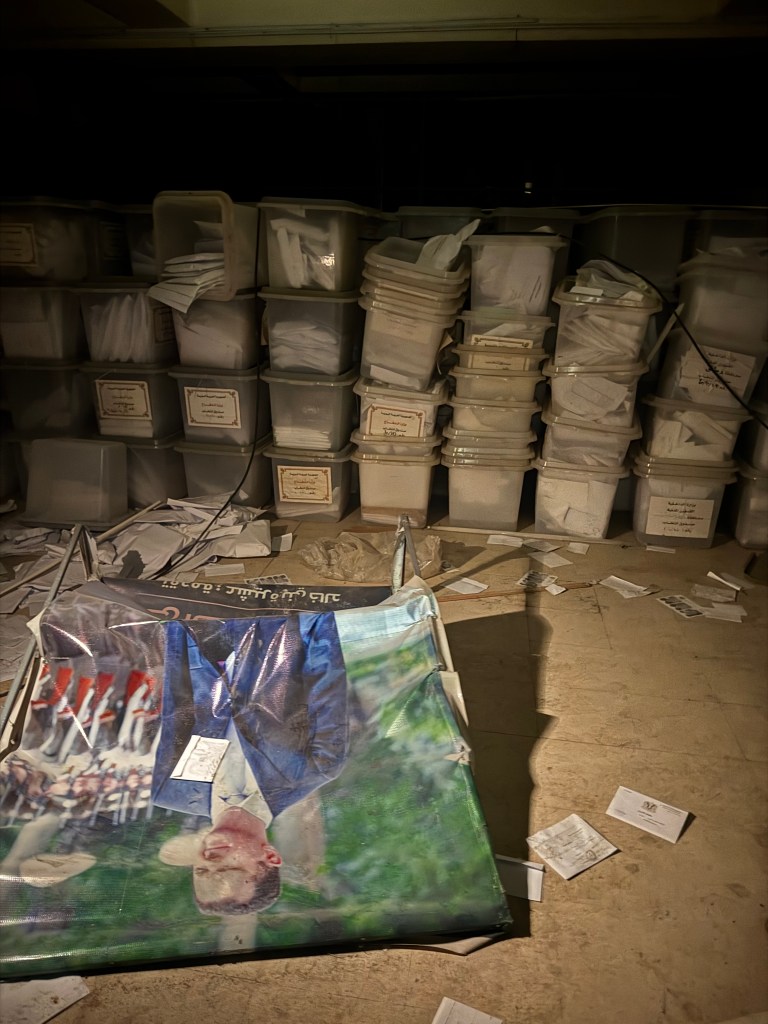
Predetermined ballots for the Assad regime, in which he won 95% of the vote (captured April 2025)
The West Needs to Stop Looking Away
If you’re still reading, thank you.
Because if there’s one thing that’s haunted me, it’s how Syria has been pushed out of view. I’ve seen people fly flags for Ukraine, rage for Gaza, and rightfully so. But when it comes to Syria? Silence. Or worse, dismissal. We are so good at moving on from things, and I get it, what lifts one person’s iron may not lift another.
But Syria is not some distant, messy conflict that doesn’t affect you. It’s a mirror and a warning. It’s a country that shows what happens when we ignore evil long enough to become numb.
Honestly, for me, it’s also personal, which I understand might make me care a little bit more. Growing up, my dad was a professional boxer and trained a guy named Mohamed Elomar. Later, he became one of Australia’s most notorious ISIS fighters. I remember my dad saying he was quiet, focused, and polite. I couldn’t understand how that same person would end up in Syria, posing for photos with his child holding a severed head. I couldn’t know how my family and I could become so close to someone so evil. It changed me, and on reflection, it’s part of what drew me to Syria in the first place.
Because the truth is: if we abandon Syria now, something worse will come. Another ISIS. Another caliphate. Another generation of broken boys with broken ideas. And it won’t just hurt Syrians. It will find its way to Paris, London, and Sydney again.
A New Beginning?
Am I hopeful?
Not really.
Syria’s future is fragile. Power vacuums, Militias, foreign meddling – yeah, it could collapse again, but it also might not, and maybe just maybe that’s enough for now.
And for a country that’s lived in the dark for this long…
That light means everything.


Leave a Reply